The Tarsar Marsar Trek is a high-altitude alpine adventure in the Kashmir Himalayas, celebrated for its twin glacial lakes, sweeping mountain meadows, and dramatic passes. The trek spans approximately 7 days of active trekking, reaches altitudes above 4,000 meters, and is best attempted between June and September. It suits moderately fit trekkers seeking a rewarding Kashmir trekking experience.
The Tarsar Marsar Trek is one of the most breathtaking Himalayan adventures, offering crystal-clear alpine lakes, scenic mountain landscapes, and unforgettable trekking experiences in Kashmir. Known for its natural beauty and challenging trails, this trek attracts adventure lovers from across India. If you are planning Kashmir Trekking in 2026, understanding the route, best time, difficulty level, and itinerary can help you prepare for an incredible journey.
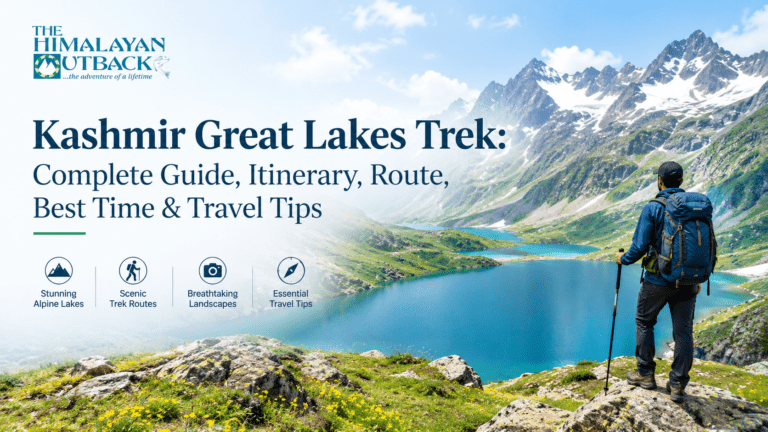
Few treks in India match the raw, unfiltered beauty of Kashmir’s alpine zones. The Tarsar and Marsar lakes — both nestled high in the Kashmir Himalayas — reward trekkers with scenery that photographs can barely do justice. Dense birch forests give way to vast meadows. Meadows rise into steep passes. And from those passes, the lakes appear like mirrors set into the earth.
This complete guide covers everything you need to know before lacing up your boots — from day-by-day itinerary and best time to visit, to packing essentials and fitness preparation.
What Is the Tarsar Marsar Trek?
| Trek Feature | Details |
| Location | Kashmir Himalayas, Jammu & Kashmir, India |
| Duration | 7–8 days of active trekking (approximately 13 days including travel) |
| Difficulty | Moderate to Challenging |
| Highest Altitude | Approximately 4,200 meters (Gadsar Pass) |
| Best Time | June–July & August–September |
| Highlights | Alpine lakes, glacial valleys, meadows, high-altitude passes |
The Tarsar Marsar Trek takes place within the Dachigam National Park corridor in the Kashmir valley. The trek is named after its two headline lakes — Tarsar and Marsar — which sit at altitudes above 3,600 meters and form the emotional centerpiece of the entire journey.
The trail passes through dense Himalayan forests, open alpine meadows frequented by nomadic Gujjar and Bakarwal tribes, and rugged high-altitude passes. Trekkers gain dramatic elevation over multiple days, making this a moderate-to-challenging route that requires prior trekking experience or strong baseline fitness.
Why Is the Tarsar Marsar Trek One of Kashmir’s Most Beautiful Treks?
Plenty of treks in India offer mountain views. Very few offer the complete package that the Tarsar Marsar Trek delivers.
Alpine lakes:Tarsar Lake and Marsar Lake are among the most visually striking high-altitude lakes in the Indian Himalayas. Their vivid blue-green waters, flanked by rocky ridgelines and snowfields, create a setting unlike anywhere else in India.
Varied landscapes: On a single day of trekking, you may walk through birch forest, cross an open meadow, scramble up a rocky pass, and descend into a glacial valley. That variety keeps every day feeling fresh.
Wildlife and wildflowers: The surrounding national park is home to Himalayan brown bears, musk deer, and a rich bird population. In summer, the meadows erupt in wildflowers — Himalayan blue poppies, primulas, and anemones carpet the trail margins.
Photography: Every campsite on this route offers compelling compositions — from pre-dawn lake reflections to golden-hour ridge silhouettes. Photographers consistently rank this among the best Kashmir adventure treks for visual storytelling.
Remoteness: Despite growing popularity, the Tarsar Marsar Trek remains far less crowded than many Himalayan alternatives. That sense of space and solitude is increasingly rare and deeply valuable.
Tarsar Marsar Trek Route Overview
The trek begins with a drive from Srinagar to the trailhead at Shekdur, approximately 3 hours along the Sindh River. From there, the route moves progressively deeper into the Kashmir Himalayas, following a sequence of valleys and passes before looping back toward Srinagar via Naranag.
Key campsites and locations along the route:
- Shekdur (3,150 m) — First campsite, maple and birch forest approach
- Nichnai (3,650 m) — Meadow camp in the wide Nichnai Valley
- Vishnusar (3,625 m) — Near the twin lakes of Kishansar and Vishnusar
- Gadsar Pass (4,200 m) — Highest point of the trek
- Gadsar Valley (3,310 m) — Long descent into wide glacial valley
- Mangan Tak (3,650 m) — Meadow camping with Himalayan views
- Gangabal Lake (3,585 m) — Final high-altitude lake camp beneath Harmukh Peak
- Naranag — Road head, return drive to Srinagar
The full KGL Trek route is circular, which means you experience new terrain with every single day. No backtracking, no repetition — just continuous forward movement through some of the most dramatic mountain scenery in India.
For the complete Kashmir Great Lakes Trek details, visit The Himalayan OutBack’s Kashmir Great Lakes Trek page.
Tarsar Marsar Trek Itinerary: Day-by-Day Journey Explained
Day 1 — Arrival in Delhi
Arrive at New Delhi International Airport. Transfer to your hotel in Aerocity. Rest and prepare for the journey ahead.
Day 2 — Delhi to Srinagar
Early morning flight to Srinagar. On arrival, transfer to your lodge. Spend the afternoon exploring the city or resting.
Day 3 — Srinagar Acclimatisation
A full day in Srinagar dedicated to acclimatisation walks in the Zabarwan mountains. Your lead guide and team will provide safety briefings and technical preparation for the days ahead.
Day 4 — Srinagar to Shekdur (Trek Begins)
A 3-hour drive takes you to the trailhead. The first day involves 4 hours of moderate-to-steep climbing through maple and birch forest, arriving at Shekdur camp at 3,150 meters.
Day 5 — Shekdur to Nichnai
A scenic 4-hour trek through meadows, forest, and the wide Nichnai Valley. Camp at 3,650 meters amid a breathtaking meadow scattered with boulders.
Day 6 — Nichnai to Vishnusar
Cross the Nichnai Pass at 3,825 meters — a steep but rewarding climb. Descend into the Vishnusar Valley and reach camp at 3,625 meters after approximately 7 hours of trekking.
Day 7 — Rest Day at Vishnusar
A scheduled rest day near the twin lakes of Kishansar and Vishnusar. Explore the lake shores, spot Himalayan wildlife, or try fly fishing with your guide team.
Day 8 — Vishnusar to Gadsar
The most demanding day. Climb to Gadsar Pass at 4,200 meters — the highest point of the trek — with panoramic views of Kishansar and Vishnusar below. Descend into the Gadsar Valley, camping at 3,310 meters after 7 hours.
Day 9 — Gadsar to Mangan Tak
A 6-hour day that begins with a steep ridge climb, transitions along a ridgeline, and descends into camp at 3,650 meters through wide meadow terrain.
Day 10 — Mangan Tak to Gangabal Lake
Cross Gangabal Pass for magnificent views of Gangabal and Nandkol lakes beneath Harmukh Peak. A 5-hour trek concludes at a lakeside camp at 3,585 meters — one of the most memorable nights on the entire route.
Day 11 — Gangabal to Naranag to Srinagar
A 5-hour final trek descends from alpine meadow to the tree line, then down to the Naranag road head. A 2-hour drive returns you to Srinagar.
Days 12–13 — Srinagar to Delhi, Departure
Return flight to Delhi. Final overnight stay before departure from India.
What Is the Best Time to Do the TarsarMarsar Trek?
The TarsarMarsar Trek is a seasonal route. Snow blocks the high passes outside the summer-autumn window, making timing critical.
June 25 – July 10: The trek opens as snow melts from the passes. Wildflowers bloom abundantly, and the meadows are a vivid green. Days are long and generally clear, though some afternoon showers are possible.
August 15 – September 15: Arguably the finest window for the KGL Trek. Weather stabilizes after the monsoon, skies clear dramatically, and the lakes reflect cloudless blue skies. Temperatures begin to drop at night, adding an atmospheric chill to the high camps.
Months to avoid: October onwards, snowfall begins to close the passes. May and early June see residual snowpack on the trail. The monsoon period between mid-July and early August can make trails slippery and increase river crossing difficulty.
For most trekkers planning a Kashmir trekking adventure in 2026, the August–September window offers the best combination of clear weather, stable conditions, and spectacular scenery.
How Difficult Is the Tarsar Marsar Trek — and How Should You Prepare?
| Trek Preparation | Why It Matters |
| Fitness Training | Helps handle 5–7 hours of daily walking on uneven terrain |
| Proper Gear | Improves safety, comfort, and warmth at high altitude |
| Weather Planning | Helps you manage rapidly changing mountain conditions |
| Guide Support | Ensures smoother trekking experience and emergency readiness |
Difficulty rating: Moderate to Challenging. Several days involve 6–7 hours of trekking with significant elevation gain.
Physical requirements: Trekkers should comfortably manage 10–15 km of daily walking before arrival. Cardiovascular fitness — built through running, cycling, or swimming — matters more than gym strength.
Altitude challenges: The trek crosses Gadsar Pass at 4,200 meters. Altitude sickness can affect anyone. A proper acclimatisation day in Srinagar, staying well hydrated, and ascending gradually all reduce risk significantly.
Fitness preparation tips:
- Begin training at least 6–8 weeks before the trek
- Walk on inclines and stairs with a loaded backpack
- Practice breathing techniques for high-altitude exertion
- Consult a doctor if you have any cardiac or respiratory conditions
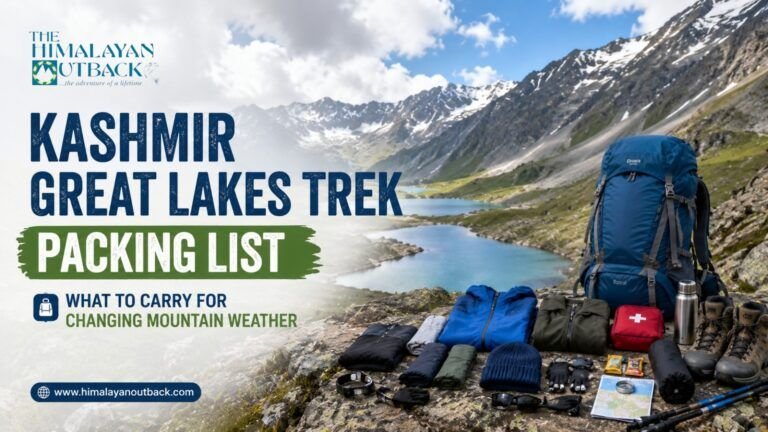
What Should You Pack for the Kashmir Great Lakes Trek?
Clothing:
- Moisture-wicking base layers (minimum 2 sets)
- Mid-layer fleece or down jacket
- Waterproof, windproof outer shell
- Trekking trousers and thermal leggings
- Warm hat, balaclava, and sun hat
- Trekking gloves (light and insulated)
Footwear:
- Waterproof, ankle-supporting trekking boots (broken in before departure)
- Lightweight camp sandals or shoes
Backpack essentials:
- 50–60 litre trekking backpack with rain cover
- Trekking poles (strongly recommended for passes)
- Headlamp with spare batteries
- Sunscreen (SPF 50+), lip balm, and UV-protection sunglasses
Medical kit:
- Altitude sickness medication (consult your doctor regarding Diamox)
- Basic first aid supplies
- Personal prescription medications
- Water purification tablets or a filter
Why Choose The Himalayan OutBack for Your Kashmir Trekking Adventure?
Choosing the right trekking partner makes a measurable difference on a route like this. The Himalayan OutBack is a specialist adventure travel company with deep expertise in Himalayan trekking and Kashmir valley routes.
Their guides carry comprehensive local knowledge of the Dachigam National Park terrain — understanding seasonal variations, emergency evacuation routes, and wildlife behavior in the area. Group sizes are capped at a maximum of 8 trekkers, ensuring a personalized, high-quality experience on every KGL Trek departure.
Safety is central to how The Himalayan OutBack operates. Every trek includes experienced lead guides, trained support staff, full camping equipment, and all-inclusive meals throughout the route. From the moment you land in Delhi to the morning you depart, their team manages every logistical detail.
Explore The Himalayan OutBack’sKashmir Great Lakes Trek experience to view full itinerary details, departure dates, and pricing.
The Tarsar Marsar Trek: A Himalayan Journey Worth Every Step
The Tarsar Marsar Trek earns its reputation. The altitude challenges are real. The passes demand effort. But what waits on the other side of every climb — a shimmering alpine lake, a sweeping glacial valley, a meadow filled with wildflowers and silence — is worth every kilometer.
Kashmir trekking at this level is a rare combination of physical challenge and natural reward. The 2026 season runs from late June through mid-September, with the August–September window offering the clearest skies and most stable conditions.
Whether you are a first-time Himalayan trekker building toward a bigger goal, or an experienced hiker seeking one of the best treks in Kashmir, this route delivers.
Ready to experience the beauty of Kashmir’s mountains and alpine lakes? Contact The Himalayan OutBack today to plan your Tarsar Marsar Trek and begin an unforgettable Kashmir Trekking adventure with expert guidance and support.
Frequently Asked Questions (FAQs)
- How many days does the Tarsar Marsar Trek take?
The full KGL Trek itinerary spans 13 days, including travel days to and from Delhi and Srinagar. Active trekking covers approximately 7 days within the Kashmir Himalayas, with one scheduled rest day near Vishnusar Lake. - Is the TarsarMarsar Trek suitable for beginners?
The trek is rated moderate to challenging and is best suited to trekkers with prior hiking experience. First-time Himalayan trekkers with good cardiovascular fitness and proper preparation can complete it successfully with a qualified guide team. - What is the best month for Kashmir Trekking on this route?
The best months for Kashmir Trekking on the TarsarMarsar route are August and September. Skies are clearest, weather is most stable, and the alpine lakes are at their most spectacular after the summer wildflower bloom. - What does The Himalayan OutBack include in the KGL Trek package?
The Himalayan OutBack’s KGL Trek package includes all accommodation (hotel and camp), all meals during the trek, experienced local guides, support staff, and transfers between Delhi, Srinagar, and the trailhead. Groups are limited to 8 trekkers for a personalized experience.