Quick answer: A flash flood in Nepal’s Rasuwa district has disrupted roads, bridges, and border access along the Trishuli/Bhote Koshi corridor, raising concerns for travellers planning Kailash Mansarovar trips and Himalayan treks. This disruption is specific to the Rasuwa region and the Nepal-Tibet overland route. It does not automatically extend to trekking destinations elsewhere in the Himalayas, including those planning trekking in Uttarakhand, India. Travellers should always confirm route-specific conditions rather than relying on general headlines.
The Himalayas span thousands of kilometers across multiple countries, and a disaster in one valley doesn’t necessarily affect a trekking trail hundreds of miles away. Still, when news breaks about a flash flood near a major pilgrimage corridor, it’s natural for trekkers and pilgrims to wonder whether their own travel plans are at risk.
This is exactly what’s happening following the flash flood reported in Nepal’s Rasuwa district. Pilgrims preparing for Kailash Mansarovar journeys and trekkers eyeing Himalayan routes have understandably started asking questions. Is the border crossing into Tibet affected? Are trekking trails in Nepal closed? And does this have anything to do with trekking in Uttarakhand, a completely different region within India?
This guide breaks down what’s currently known, explains why geography matters when assessing Himalayan travel risk, and offers practical guidance for anyone planning a trek in the months ahead — whether that’s toward Kailash Mansarovar or toward the trails of trekking in Uttarakhand.
What Happened in the Rasuwa Flash Flood?
According to the latest available updates, a flash flood struck the Rasuwa district of Nepal, affecting communities and infrastructure along the Trishuli and Bhote Koshi river corridors. This area sits close to the Nepal-Tibet border and includes towns that serve as key stops for travellers heading toward the Rasuwagadhi/Kerung border crossing.
Flash floods in this part of the Himalayas are often linked to intense monsoon rainfall, glacial lake activity, or sudden river surges — conditions that can develop quickly and with limited warning. The exact cause and scale of damage should be confirmed through official Nepali government and disaster management sources, as route conditions can change quickly in the aftermath of an event like this.
The reason this flood matters beyond the immediate area is its location. Rasuwa isn’t just a district — it’s a transit corridor. Damage here can ripple outward to affect road access, border logistics, and travel scheduling for people well beyond the flood zone itself.
Which Areas Were Most Affected?
Reports point to disruption in and around Rasuwa town, the Rasuwagadhi border area, Timure, and sections of the road network connecting Syabrubesi to the border. It’s important to separate two different things here:
- Damage to community infrastructure — roads, bridges, buildings, and utilities in towns along the corridor.
- Damage to trekking trails — the actual footpaths used by trekkers, which may or may not be directly affected depending on their location relative to the flood.
A road washout or damaged bridge can disrupt vehicle access to a trekking region without necessarily destroying the trekking trail itself. This distinction matters because it’s easy for headlines to blur the two, leaving travellers uncertain about what’s actually closed.
Travellers should confirm the latest official route status before departure, ideally through Nepal’s Department of Tourism, local trekking associations, or an experienced operator with current, on-the-ground information.
How Has the Rasuwa Flood Affected Kailash Mansarovar Travel?
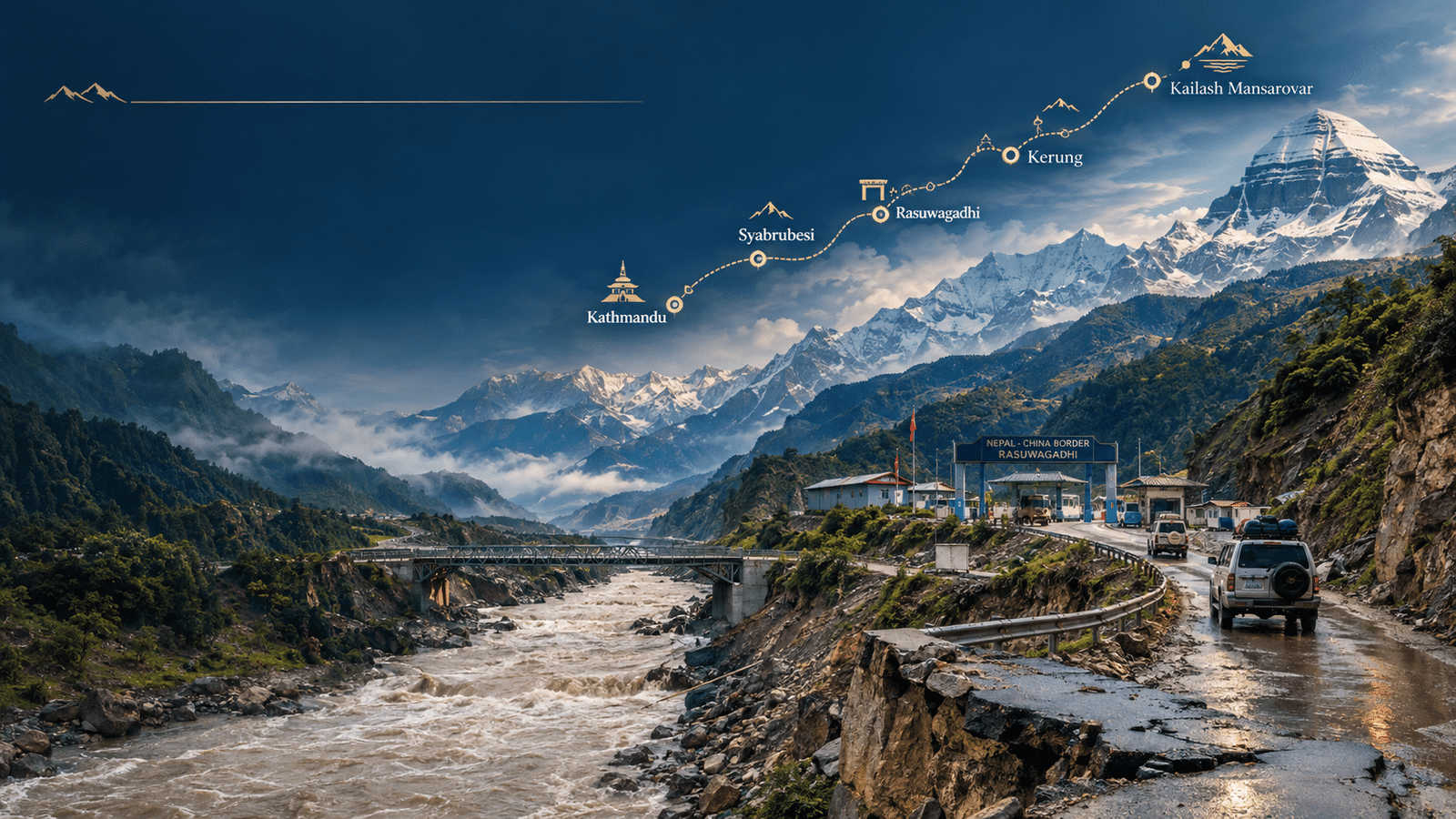
The Rasuwagadhi/Kerung corridor is one of the primary overland routes used by Indian pilgrims travelling to Kailash Mansarovar via Nepal into Tibet. When this corridor experiences infrastructure damage, it can affect several parts of the journey, including:
- Road access between Kathmandu and the border
- Border crossing operations at Rasuwagadhi/Kerung
- Bridges along the approach road
- Transport scheduling for pilgrim groups
- Overall pilgrimage logistics, including permits and coordination with Chinese authorities on the Tibet side
Because this is a fast-moving situation, this guide will not speculate on reopening timelines. Anyone with a planned Kailash Mansarovar journey should stay in close contact with their tour operator and monitor official updates from both Nepali and Indian authorities.
Is the Kailash Mansarovar Route Open?
Based on the latest available information at the time of writing, the status of the Rasuwagadhi/Kerung corridor remains a developing situation. Travellers should not assume the route is either fully closed or fully operational without checking current official guidance. If your pilgrimage is scheduled in the near term, contact your operator directly for the most current, verified information before finalizing travel arrangements.
What Does the Flood Mean for Himalayan Trekking Trails?
A flash flood in one corridor doesn’t mean every Himalayan trekking trail is at risk. But it’s a useful reminder that trekking conditions depend on several localized factors, including:
- Current trail condition and erosion
- Road access to trailheads
- Bridge integrity along the route
- Landslide risk in the surrounding terrain
- River crossing conditions
- Recent and forecast weather
- Access for rescue and emergency services
- Local government or tourism board advisories
Each Himalayan trekking region — whether in Nepal, Tibet, or India — has its own watershed, weather pattern, and access infrastructure. Assessing one region tells you very little about the safety of another.
Are Other Himalayan Trekking Routes Affected?
Not necessarily. Nepal alone has dozens of trekking regions, from Everest and Annapurna to Manaslu and Langtang, each with distinct access roads and terrain. A flood affecting the Rasuwa corridor is most relevant to routes that pass through or near that specific area, such as parts of the Langtang region. It says little about trekking conditions in unrelated valleys.
The same logic applies on a larger scale when comparing Nepal to India. This is where the situation becomes directly relevant to anyone researching trekking in Uttarakhand.
What Does This Mean for Trekking in Uttarakhand?
This is the question many Indian trekkers are asking, and it deserves a clear answer: trekking in Uttarakhand is a separate consideration from the Rasuwa flood in Nepal.
Uttarakhand sits within India, with its own mountain ranges, river systems, road networks, and weather patterns. The Rasuwa district and the Rasuwagadhi/Kerung border corridor are located in Nepal, geographically distinct from Uttarakhand’s trekking regions such as the Garhwal and Kumaon Himalayas. A flood disrupting infrastructure in Nepal doesn’t travel across borders to affect trails in another country entirely.
That said, this doesn’t mean trekking in Uttarakhand should be planned without due diligence. Every Himalayan region, including Uttarakhand, has its own seasonal risks — monsoon landslides, river swelling, and altitude-related considerations among them. Anyone planning trekking in Uttarakhand should check current local weather forecasts, road conditions, and any advisories issued by state tourism or disaster management authorities before departure.
In short: don’t let headlines about Rasuwa create unnecessary hesitation about trekking in Uttarakhand, but do treat trekking in Uttarakhand — like any Himalayan trek — as something that requires its own, independent check of current conditions.
Why Responsible Trekking Matters After a Himalayan Disaster
Responsible trekking becomes especially important in the aftermath of a natural disaster like the Rasuwa flood. This means:
- Respecting local access restrictions rather than attempting to push through closed routes
- Avoiding travel into flood-affected areas that could strain local rescue and relief resources
- Supporting affected communities through registered, ethical tourism spending rather than avoiding the wider region altogether
- Following instructions from local authorities and licensed guides
- Choosing experienced, registered trekking operators who maintain current route knowledge
- Carrying appropriate safety and communication equipment
- Keeping emergency contacts accessible at all times
- Avoiding the spread of unverified information on social media, which can create confusion during an already stressful situation
Responsible trekking isn’t just about personal safety — it’s about ensuring your presence doesn’t add pressure to communities and services that may already be stretched thin.
Himalayan Trekking Safety: What Travellers Should Check Before Departure
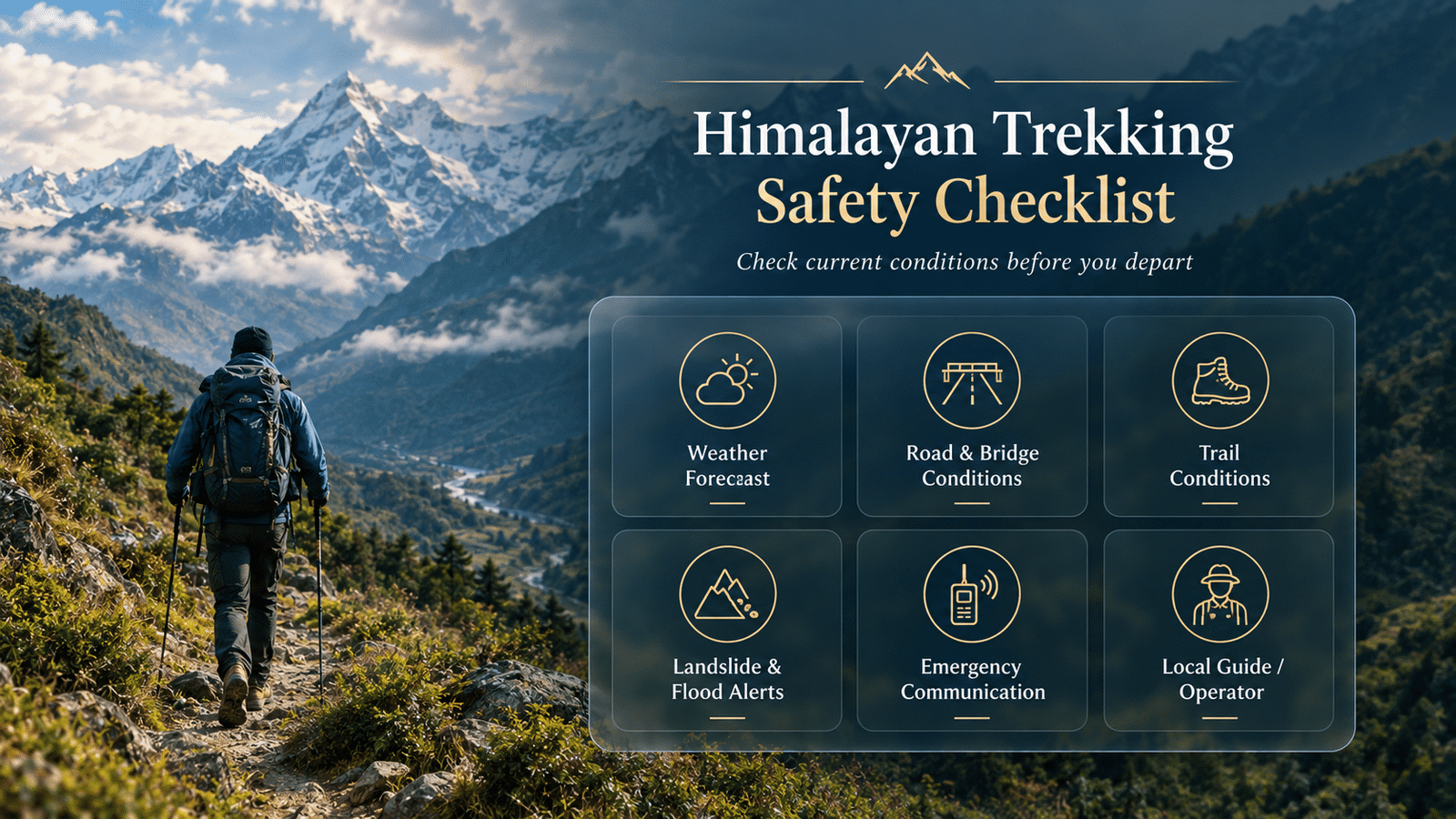
Trekking safety in the Himalayas — whether in Nepal, Tibet, or while trekking in Uttarakhand — depends on doing your homework before you set out. Key things to verify include:
- Current weather forecasts for your specific route
- Official route status from tourism boards or local authorities
- Road and bridge conditions along your access route
- Trail conditions, including recent erosion or landslide activity
- Landslide and flash-flood warnings for the season
- Availability of emergency communication (satellite phones, local network coverage)
- Adequate travel insurance covering trekking and evacuation
- Basic medical preparedness, including a first-aid kit
- Altitude considerations if trekking above 10,000 feet
- Updates from your local guide or operator, who typically has the most current ground information
- Emergency evacuation arrangements in case conditions change mid-trek
These checks apply regardless of destination, and they’re just as relevant for a first-time trekker planning trekking in Uttarakhand as they are for an experienced Kailash Mansarovar pilgrim.
Comparing Himalayan Travel Areas After the Rasuwa Flood
|
Travel Area |
Current Concern to Check | Why It Matters | Traveller Action |
|
Rasuwa, Nepal |
Roads, bridges and local access | Infrastructure was affected by the flood |
Confirm route status with local authorities |
|
Rasuwagadhi/Kerung |
Border and road access | Important for overland Kailash Mansarovar travel |
Verify current border information before travel |
|
Langtang Region |
Trail and access conditions | Trail status and road access can differ from the main flood zone |
Check route-specific updates with your operator |
|
Other Nepal Treks |
Local weather and access | Different watersheds carry different risk levels |
Confirm current conditions with your operator |
| Uttarakhand | Local weather and route conditions | A separate Himalayan region within India |
Check local advisories before trekking in Uttarakhand |
Planning Your Next Himalayan Trek
Choosing the right route after an event like the Rasuwa flood comes down to a handful of practical factors: current ground conditions, your experience level, the season you’re travelling in, accessibility, safety requirements, trek duration, fitness level, and the level of local support available on your chosen route.
This is where working with an experienced operator makes a real difference. The Himalayan Outback has spent years guiding trekkers through the Uttarakhand Himalayas, offering route guidance, trek planning support, and responsible trekking advice tailored to current conditions. If you’re weighing your options for trekking in Uttarakhand, exploring the Uttarakhand trekking routes available through The Himalayan Outback is a practical next step toward a well-planned, safely managed trek.
Plan With Confidence, Not Assumptions
News of a disaster in one part of the Himalayas naturally raises questions for anyone with travel plans in the region. But the Himalayas are too vast and too varied for a single event to define the whole range. The Rasuwa flash flood is a serious situation for the communities and travellers directly affected along that corridor, particularly those relying on the Rasuwagadhi/Kerung route toward Kailash Mansarovar. It is not, however, a reason to assume that trekking in Uttarakhand or other unrelated Himalayan regions is automatically disrupted.
The safest approach is always the same: check route-specific, current information rather than relying on general headlines, and lean on experienced operators who track ground conditions closely.
If you’re planning a Himalayan adventure — whether that’s a pilgrimage route, a classic trek, or trekking in Uttarakhand — reach out to The Himalayan Outback to discuss current route conditions, suitable trek options, and responsible trekking practices before you finalize your plans.
Frequently Asked Questions
What happened in the Rasuwa flash flood?
A flash flood struck Nepal’s Rasuwa district, affecting roads, bridges, and local infrastructure along the Trishuli/Bhote Koshi corridor near the Nepal-Tibet border. The full extent of the damage should be confirmed through official sources, as conditions were still developing at the time of writing.
How has the Rasuwa flood affected Kailash Mansarovar travel?
The flood has raised concerns about the Rasuwagadhi/Kerung corridor, a key overland route for Indian pilgrims travelling to Kailash Mansarovar via Nepal. Effects may include disrupted road access, border crossing delays, and changes to pilgrimage logistics. Travellers should confirm the latest status directly with their operator.
Is trekking in Uttarakhand affected by the Rasuwa flood?
No direct connection has been established. Uttarakhand is a separate Himalayan region within India, geographically distinct from Rasuwa in Nepal. Anyone planning trekking in Uttarakhand should still check current local weather and route advisories, but there’s no indication that the Rasuwa flood affects Uttarakhand’s trekking trails.
What should trekkers check before travelling in the Himalayas?
Trekkers should verify current weather forecasts, official route status, road and bridge conditions, landslide risk, and local advisories. Travel insurance, emergency communication, and guidance from an experienced local operator are also essential before setting out.